Flat vs conventional wiper blades: which is better for your car?
Flat (or beam) wiper blades use a curved spring-steel spine to press the rubber evenly along its whole length and have no exposed frame to collect ice. Conventional blades use a jointed metal frame that presses down through a series of claws. Neither is better on every car: the right choice is a blade that fits your arm, is the correct length for each side, and suits the screen it was designed for.
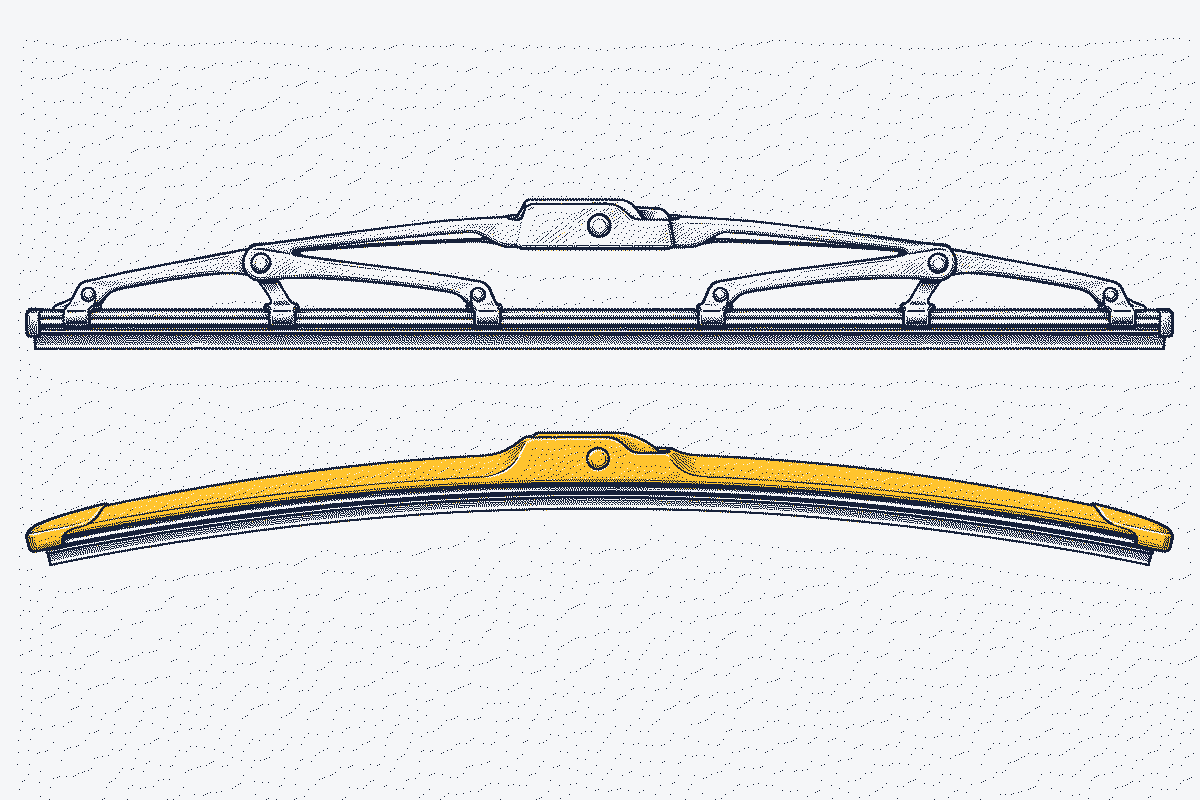
What is the difference between flat and conventional wiper blades?
The difference is how the pressure from the wiper arm reaches the rubber.
Conventional blades have a metal frame made of linked sections. The arm presses on the middle of the frame, and the frame passes that force to the rubber through several small claws. The joints let the frame flex to follow the screen.
Flat blades, also called beam or frameless blades, have no frame. A pre-curved strip of spring steel runs inside or along the rubber. When the arm presses it onto the glass, the spine flattens against the screen and spreads the pressure along the whole length.
Hybrid blades sit between the two. They have a frame underneath for pressure, covered by a plastic shell or spoiler that gives a lower, smoother profile.
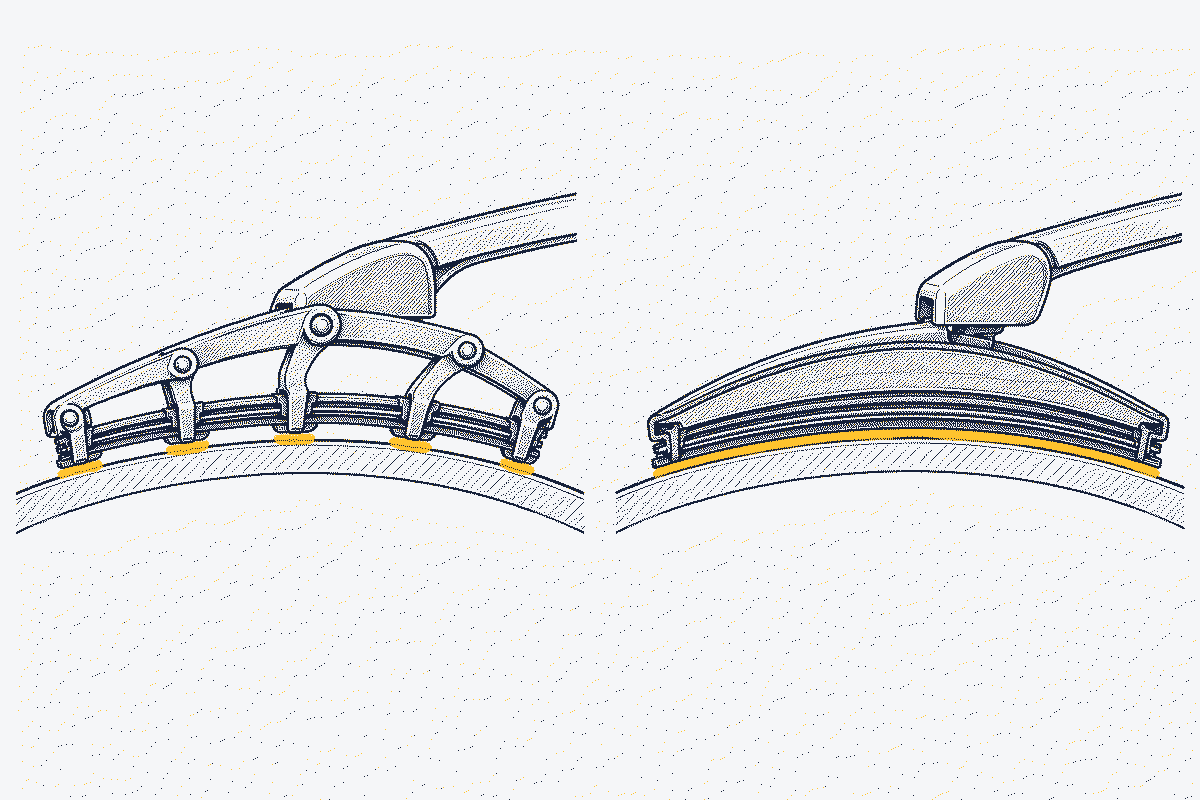
Flat vs conventional wiper blades: how do they compare?
| Conventional (framed) | Flat (beam) | Hybrid | |
|---|---|---|---|
| Construction | Jointed metal frame with claws | Spring-steel spine, no frame | Frame under a plastic cover |
| How pressure is applied | Through a few contact points | Along the full length | Through a frame, covered |
| Ice and snow | Open frame and joints can clog or freeze | Nothing exposed to clog | Cover keeps most of the frame clear |
| Profile | Tall | Low | Low to medium |
| Handedness | Usually symmetric | Often asymmetric, left or right specific | Often asymmetric |
| Arm fittings | Commonly hook | Often supplied with several adapters | Often supplied with several adapters |
The table describes the designs, not any particular brand. Quality varies within each type, and a well-made framed blade can outperform a poor flat one.
Are flat wiper blades better in winter?
The design gives them an advantage. A conventional blade has an open frame with joints and claws, and snow or slush can pack into it and freeze. That can stop the frame flexing, so the rubber lifts off the glass in places and leaves streaks.
A flat blade has nothing exposed to fill with ice, so it tends to keep its shape against the screen in cold weather. A hybrid's cover does a similar job for the frame beneath it.
Whatever you fit, the basics matter more in winter than the blade type. Never run the wipers on a frozen screen, as it can tear the rubber. Our winter visibility checklist covers de-icing and screenwash.
Do flat blades work better on curved windscreens?
Often, yes. A flat blade's spine is pre-curved to suit the screen it's designed for, so it can follow strong curves, especially near the ends of the sweep, without relying on a few pressure points.
A framed blade can follow curves too, but the rubber between the claws is less firmly supported. On a strongly curved screen that can show up as an unwiped strip or a blade that lifts at speed. If you have those symptoms, our guide to streaky or juddering wipers runs through the other causes first.
Can you swap conventional wiper blades for flat ones?
Usually, as long as two things line up.
The connector must match your arm. The wiper arm's end fitting doesn't change, so the new blade has to fit it, either directly or with an adapter in the pack. Hook arms are the most common in our data (101 of 231 verified front fittings), and most replacement blades of every type cater for them. Less common fittings narrow the choice. Our guide to wiper blade connector types shows how to identify yours.
The length and side must be right. Keep to the lengths listed for your car. Because flat and hybrid blades are often asymmetric, check the pack shows which is the driver's blade, and make sure it's a set for a right-hand-drive car. A left-hand-drive set can sit wrong on a UK car. Our guide to driver and passenger blades explains how to spot it.
Going the other way, from factory flat blades to framed ones, is less straightforward. Some arms fitted to cars that came with flat blades have fewer framed blade options, so check the fitting before you buy.
Which type should you choose?
A practical way to decide:
- Match what the car came with if you're happy with it. The manufacturer chose the blade type and arm pressure together.
- Consider flat or hybrid if you park outside through the winter, or your framed blades leave strips on a curved screen.
- Stick with conventional if your arm fitting has limited flat options, or your current framed blades clear the screen well.
Whatever you choose, the blades have to clear the screen. The MOT requires the wipers to give an adequate view of the road, so a blade that leaves a strip in the driver's view is a problem whichever type it is.
Check your car
Each FitsMyCar wiper page lists the driver's, passenger and rear lengths and the arm fitting, with the source we checked it against:
- Ford Focus Mk3 wipers:
28"/28"/12", push button - VW Golf Mk7 wipers:
26"/18"/11", push button - Ford Fiesta Mk7 wipers:
26"/15"/12", hook - Vauxhall Corsa D wipers:
26"/16"/12", pinch tab
Browse every car from the wipers index or all makes, and see how to measure wiper blades if you want to double-check what's fitted.
Common questions
Are flat wiper blades worth it?
They suit cars parked outside in winter and cars with strongly curved screens. If your conventional blades clear the screen well and fit your arm, there's no need to change type, just replace them when they wear.
Can I mix a flat blade on one side and a conventional blade on the other?
It works mechanically if both fit, but the two can wipe differently and look mismatched. Fitting the same type on both sides gives the most even result.
What is a hybrid wiper blade?
A hybrid has a framed blade underneath, covered by a plastic shell or spoiler. It aims to combine a frame's pressure with a lower profile and less exposed metal.
Do flat wiper blades fit hook arms?
Most do, because flat blades are commonly sold with a hook adapter fitted or in the pack. Check the pack lists your hook size.
Checked against our verification rules. Spotted something wrong? Tell us.