How to read a car bulb code
A car bulb code tells you the bulb's shape, base and power, and sometimes its colour. In W5W, the first W means a glass wedge base and 5W means 5 watts; in PY21W, P is a metal bayonet cap, Y means amber and 21W is 21 watts. Headlight codes such as H7 and H4 are type numbers rather than wattages, and a slash, as in P21/5W, means two filaments in one bulb.
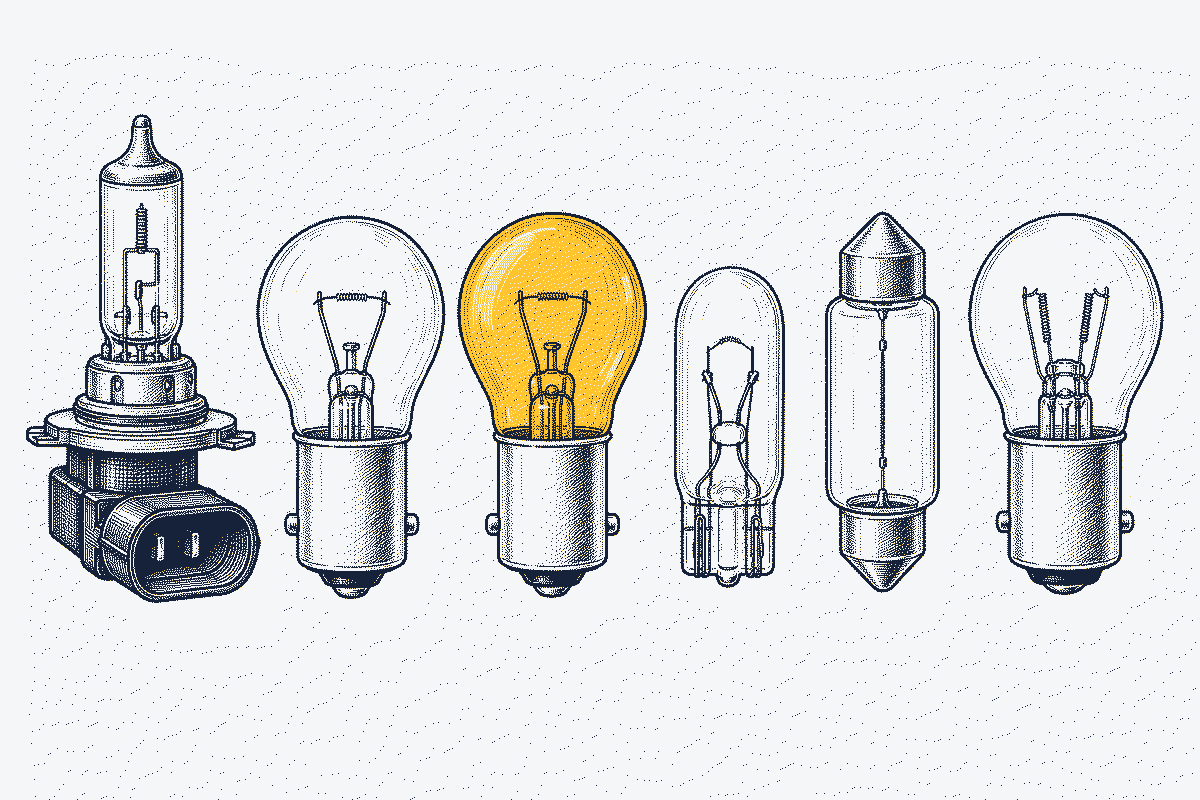
Once you can read the code, you can buy the right bulb with confidence. You still need the right code for your car, though, and that comes from the handbook or a verified source rather than from guessing.
What do the letters in a car bulb code mean?
The letters describe the bulb's construction. These are the ones you'll meet on almost every UK car:
- H – a halogen headlamp or fog bulb type, such as
H7,H4,H1orH11. The number after it identifies the type, not the power. - HB – also a halogen headlamp type, with a US-style number that is often printed alongside it:
HB3is the same bulb as9005, andHB4is9006. - W at the start – a glass wedge base with no metal cap, as in
W5W,W16WandW21W. The bulb pushes straight into its holder. - P – a round glass bulb on a metal bayonet cap, as in
P21WandP21/5W. You push in and twist to fit it. - C – a festoon bulb: a glass tube with a metal cap at each end, as in
C5W. These are common in number plate and interior lamps. - R – a smaller round bayonet bulb, as in
R10W. - Y – amber.
PY21W,WY21WandPWY24Ware all amber bulbs for indicators.
Small bayonet bulbs such as H6W and H21W also start with H, but they are nothing like a headlamp bulb. Read the whole code, not just the first letter.
Is the number in a bulb code the wattage?
It depends on the type. For signal and small bulbs, the number followed by W is the wattage: W5W is 5 watts, P21W is 21 watts and W16W is 16 watts.
For headlamp codes it is not. H7 is a 55 W bulb, H4 is 60/55 W and H8 is 35 W. The number simply tells you which standard bulb type it is, and each type has its own base and filament position.
What does the slash in P21/5W mean?
A slash means the bulb has two filaments, and each number is one filament's wattage. In P21/5W, the 21 W filament is the brake light and the 5 W filament is the tail light, so one bulb does both jobs.
The same idea applies to headlamps. An H4 (60/55 W) has a main beam filament and a dipped beam filament in one bulb, and an H15 (55/15 W) combines main beam with a daytime running light. Our guide to brake light bulb types covers the twin-filament rear bulbs in more detail.
What are base codes like BA15s and PX26d?
The base code describes how the bulb physically fits the holder. You'll usually see it on the packaging or in a technical table, and it explains why similar-looking bulbs won't swap.
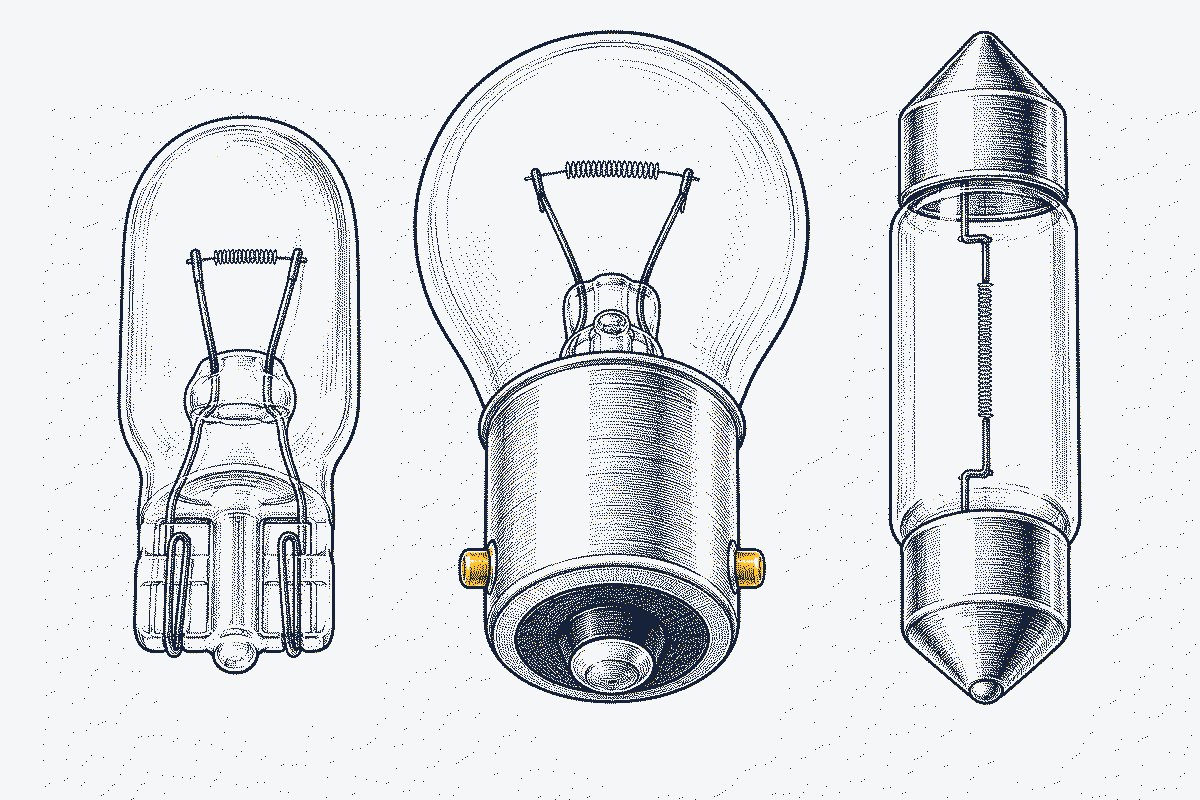
The bayonet bulbs are the best example. A P21W uses BA15s, with its two pins level. A PY21W uses BAU15s, with the pins offset so it can't go into a P21W socket. A P21/5W uses BAY15d, with pins at different heights so the two filaments line up with the right contacts. Our PY21W vs P21W guide explains why that matters for indicators.
The 15 bulb codes you'll meet most often
The counts below come from the 360 UK car generations we've verified so far, where each value has been checked against the owner's handbook or two independent sources.
| Code | Type | Base | Where it's used in our data |
|---|---|---|---|
H7 | Single filament, 55 W | PX26d | Dipped beam on 201 generations, main beam on 89 |
H4 | Twin filament, 60/55 W | P43t | Dipped beam on 74, main beam on 73 |
H1 | Single filament, 55 W | P14.5s | Main beam on 56 |
H11 | Single filament, 55 W | PGJ19-2 | Front fog on 98, dipped beam on 20 |
H8 | Single filament, 35 W | PGJ19-1 | Front fog on 57 |
HB3 (9005) | Single filament, 60 W | P20d | Main beam on 25 |
HB4 (9006) | Single filament, 51 W | P22d | Front fog on 22 |
H15 | Twin filament, 55/15 W | PGJ23t-1 | Main beam and daytime running light on 21 |
W5W | Glass wedge, 5 W | W2.1x9.5d | Sidelight/DRL on 175, number plate on 172 |
C5W | Festoon, 5 W, 36 mm | SV8.5 | Number plate on 32 |
PY21W | Amber bayonet, 21 W | BAU15s | Front indicator on 192, rear indicator on 155 |
P21W | Bayonet, 21 W | BA15s | Rear fog on 141, reverse on 106 |
P21/5W | Twin filament bayonet, 21/5 W | BAY15d | Brake/tail on 111 |
W16W | Glass wedge, 16 W | W2.1x9.5d | Reverse on 114 |
W21W | Glass wedge, 21 W | W3x16d | Rear fog on 31 |
These are counts from our verified data, not a share of every car on UK roads. They do show how a handful of codes cover most positions, and why the odd ones out catch people out.
Why can one car need several different codes?
A single car can use a long list of bulb types. A Ford Fiesta Mk7 uses H7 dipped, H1 main, H11 fog, PY21W indicators, P21/5W brake/tail, W16W reverse, P21W rear fog and W5W number plate bulbs.
Some cars break the usual pattern. The Vauxhall Astra J uses PSY24W at the front, a W16W for the rear indicator and H21W for reverse and rear fog. The Mini Hatch R56 uses C5W festoons for the number plate where most cars use W5W.
Codes can also change within one model. A facelift, a different trim (halogen, xenon or LED headlamps) or a different body style can mean a different bulb, so check the exact generation rather than the model name. If you're not sure which generation you have, see which generation is my car.
How do I find the right bulb code for my car?
There are three reliable ways:
- Your owner's handbook. Look in the maintenance or technical data section for a bulb table. Our guide to finding the bulb table in the handbook shows where it usually sits.
- The old bulb. The code is normally stamped on the base or the metal cap. It tells you what's fitted now, which may not be what the car should have.
- A verified fitment page. Each FitsMyCar car page lists every position with the source it was checked against.
Check your car
Look up your car's full bulb list by generation:
- Ford Fiesta Mk7 bulbs and Ford Fiesta Mk8 bulbs
- VW Golf Mk7 bulbs
- Vauxhall Corsa D bulbs
- Nissan Qashqai J11 bulbs
- Toyota Yaris XP130 bulbs
Not listed? Browse every car we cover on the bulbs page or by make.
Common questions
What does W5W mean on a bulb?
W5W is a 5 W bulb with an all-glass wedge base (W2.1x9.5d). It's the most common sidelight and number plate bulb in our data, used for sidelights on 175 generations and number plates on 172.
Are bulbs with the same wattage interchangeable?
No. P21W, W21W and PY21W are all 21 W, but they have different bases or colours and won't swap. Match the full code, not just the wattage.
What does the Y in PY21W mean?
Y means the bulb glass is amber. Amber bulbs are used for indicators behind clear lenses, and on bayonet types such as PY21W the base is different from the clear version so the two can't be mixed up. Wedge types such as WY21W share the clear bulb's base, so match the full code.
Does "LED" in a bulb list mean I can buy an LED bulb?
Usually not. On our car pages, "LED" means the light is a factory-fitted LED unit, often non-replaceable. It is not a bulb code, and fitting LED bulbs into halogen headlamps is a separate question covered in are LED headlight bulbs legal in the UK.
Checked against our verification rules. Spotted something wrong? Tell us.