PY21W vs P21W vs WY21W: indicator bulbs explained
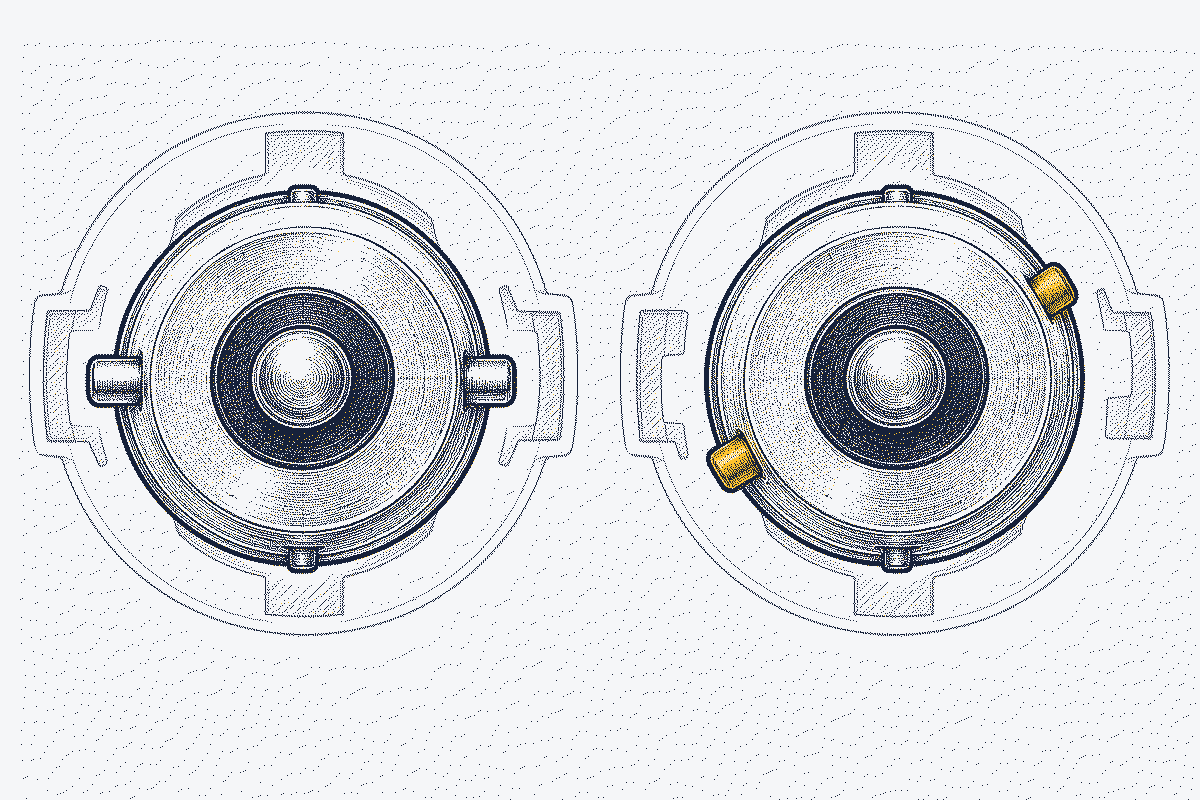
The difference between PY21W vs P21W is colour and base. A PY21W is an amber 21 W bayonet bulb with offset pins (BAU15s), used behind a clear indicator lens. A P21W is a clear 21 W bayonet bulb with level pins (BA15s), used for reverse, rear fog and some indicators behind an amber lens. A WY21W is a 21 W amber bulb with a glass wedge base instead of a metal cap.

Because the pins are different, a PY21W and a P21W won't fit each other's sockets. Buy the exact code listed for your car and position.
What is the difference between PY21W and P21W?
Both are 21 W single-filament bulbs on a round metal bayonet cap. The Y in PY21W means the glass is amber, and the base is changed to match.
| Code | Colour | Base | Pins | Typical use |
|---|---|---|---|---|
PY21W | Amber | BAU15s | Offset | Indicators behind a clear lens |
P21W | Clear | BA15s | Level (opposite each other) | Reverse, rear fog, indicators behind an amber lens |
WY21W | Amber | Glass wedge | No cap | Indicators where the holder takes a wedge bulb |
PWY24W | Amber | Wedge-base | No metal cap | Indicators, mainly front, on some newer cars |
WY16W | Amber | Wedge | No cap | Rear indicators on a few cars |
For more on how codes are built, see how to read a car bulb code.
Why do PY21W bulbs have offset pins?
To stop the wrong colour ending up in the wrong light. Indicators must show amber. Many modern cars use clear lenses over their indicators, so the amber colour has to come from the bulb itself.
If a clear P21W could be pushed into that socket, the indicator would flash white through a clear lens. The offset pins on the PY21W make that physically impossible, and they also stop an amber bulb being fitted into, say, a reverse light that should be white.
Can I use a P21W instead of a PY21W?
No. It won't lock into the socket, and if it could, the indicator would show the wrong colour. Indicators and hazard lights are checked on every UK MOT.
The reverse is also true: a PY21W won't fit a P21W socket. The only time a clear P21W is correct for an indicator is when the car maker has designed the lamp with an amber lens, and the handbook lists P21W for that position. The BMW 3 Series F30, for example, uses a P21W for its rear indicators.
Which indicator bulbs are most common?
Across the 360 UK car generations we've verified, PY21W is by far the most common indicator bulb:
| Position | PY21W | WY21W | PWY24W | P21W | WY16W | LED |
|---|---|---|---|---|---|---|
| Front indicator | 192 | 26 | 23 | – | – | 13 |
| Rear indicator | 155 | 38 | – | 20 | 9 | 19 |
These figures describe the cars we've verified, not every car on UK roads. They do show that front and rear can differ on the same car, so don't assume one code covers all four corners.
Which cars use which indicator bulb?
Some verified examples:
| Car | Front | Rear |
|---|---|---|
| Ford Fiesta Mk7 | PY21W | PY21W |
| Nissan Qashqai J11 | PY21W | WY21W |
| VW Golf Mk7 | WY21W | WY21W |
| Audi A3 8V | PWY24W | PY21W |
| Ford Kuga Mk3 | PWY24W | WY21W |
| BMW 3 Series F30 | PY21W | P21W |
| Vauxhall Astra J | PSY24W | W16W |
| Renault Clio V | LED | WY16W |
The Astra J is the odd one out. It uses a PSY24W at the front, a different 24 W amber bulb from the PWY24W, and a W16W wedge bulb for the rear indicators, which is the same code many cars use for reverse lights. If you own one, buy by the exact code rather than by what "indicator bulbs" usually are.
Values can split by facelift or body style, so check your generation's page before buying.
Why is my indicator flashing fast?
A fast flash is usually the car telling you a bulb has failed. The flasher circuit detects that less current is being drawn and speeds up, so the fast side is normally where the dead bulb is. Check front, rear and any side repeater on that side.
The same thing can happen after fitting LED indicator bulbs. LEDs draw much less current than a 21 W filament bulb, so the car can read them as a failed bulb and flash fast, or show a bulb warning on the dashboard. Fitting the correct filament bulb for the code your car lists avoids the problem.
If the flash rate is wrong with correct bulbs fitted, check the bulb is seated properly and the holder contacts are clean. Corrosion in a rear lamp holder can also make a bulb work intermittently.
Do I need to replace indicator bulbs in pairs?
No. Unlike headlamp bulbs, there's no beam to match. Replace the failed bulb with the same code and check the others while you're there. Our guide on replacing headlight bulbs in pairs explains where pairs do matter, and how to check your car lights on your own covers testing indicators without a helper.
Check your car
Find the front and rear indicator bulbs for your generation:
- Ford Fiesta Mk7 and Ford Kuga Mk3
- VW Golf Mk7 and Audi A3 8V
- Vauxhall Astra J
- BMW 3 Series F30
- Nissan Qashqai J11
Or browse every car on the bulbs page.
Common questions
Is PY21W the same as P21W?
No. Both are 21 W bayonet bulbs, but the PY21W is amber with offset pins (BAU15s) and the P21W is clear with level pins (BA15s). They won't fit each other's sockets.
Can I use WY21W instead of PY21W?
No. A WY21W has a glass wedge base and a PY21W has a metal bayonet cap, so they need different holders. Use whichever your car lists for that position.
Why does my car use a clear bulb for the indicator?
Some lamps have an amber lens, so the colour comes from the lens rather than the bulb. In that case a clear P21W is correct. If your lens is clear, the bulb must be amber.
Will an LED indicator bulb pass the MOT?
The MOT checks that indicators and hazard lights work. LED replacements can cause fast flashing or bulb warnings, so the simplest route is the filament bulb your car lists. If you're unsure about a particular product, check the MOT inspection manual.
Checked against our verification rules. Spotted something wrong? Tell us.